
Friday, October 31, 2008

Wednesday, October 29, 2008
Preparing for Sunday, Nov. 2

This week, we reach the conclusion of our series on the Apostle’s Creed. We left the phrase “I believe in the communion of saints” to explore on All Saints Sunday. This Sunday, we will celebrate communion and honor the two members of New Life who have entered into the Church Triumphant as well as remember and celebrate all the many saints that have impacted our lives. Our Scripture this week comes from the book of Hebrews and begins near the end of the roll call of the faithful found in Chapter 11:
32And what more should I say? For time would fail me to tell of Gideon, Barak, Samson, Jephthah, of David and Samuel and the prophets— 33who through faith conquered kingdoms, administered justice, obtained promises, shut the mouths of lions, 34quenched raging fire, escaped the edge of the sword, won strength out of weakness, became mighty in war, put foreign armies to flight. 35Women received their dead by resurrection. Others were tortured, refusing to accept release, in order to obtain a better resurrection. 36Others suffered mocking and flogging, and even chains and imprisonment. 37They were stoned to death, they were sawn in two, they were killed by the sword; they went about in skins of sheep and goats, destitute, persecuted, tormented— 38of whom the world was not worthy. They wandered in deserts and mountains, and in caves and holes in the ground. 39Yet all these, though they were commended for their faith, did not receive what was promised, 40since God had provided something better so that they would not, apart from us, be made perfect.• What do you think of when you hear the word “saint”? What kind of person comes to mind? Do you think of yourself as a saint?
12Therefore, since we are surrounded by so great a cloud of witnesses, let us also lay aside every weight and the sin that clings so closely, and let us run with perseverance the race that is set before us, 2looking to Jesus the pioneer and perfecter of our faith, who for the sake of the joy that was set before him endured the cross, disregarding its shame, and has taken his seat at the right hand of the throne of God. (Hebrews 11:32-12:2)
• Glance at chapter 11 and see the long list of names that are proclaimed for their faith. Think over their stories (if you are unfamiliar with them, look them up in a Bible Dictionary and find out something about them). Most of them (to borrow from Paul) were not wise by human standards, not powerful of noble birth nor did they always act much like saints. What made them worthy of mention?
• What does it mean to you say confess that you believe in the communion (that is fellowship) of the saints?
• Paul talks about us being surrounded by a great cloud of witnesses. Would it make a difference in how you live your life and in how we do ministry in our congregation to imagine being surrounded by those who passed the gospel on to us?
• Notice that Paul says these witnesses to the faith did not receive what was promised so that they could receive something better? What was the better thing they received? And what is our role in their receiving the promise?
• Finally, reflect on those who first shared the gospel with you? Who shared it with them? Are you running the race in such a manner that honors their gift to you?
See you on Sunday!
Monday, October 27, 2008

Sunday, October 26, 2008

Saturday, October 25, 2008
Weekly Review
 Lots of thought provoking articles and reflections on the web this week! Many of them focused on the upcoming election and our Christian response to it. I have hesitated to share any of them after several strong reactions by people to reflections on the election. I confess that I am getting very weary not of the election itself or even of the normal negative ads, constant news coverage, and ever changing suspect polls of voters. (One would think we didn't need to have an election simply let the pollsters make the selection!) What I am weary of is the ugliness of discourse among people and especially among Christians! And as at least one blogster stated: perhaps what is most important is not who we vote for on November 4th but how we react (whether our candidate wins or loses) on November 5th.
Are you a November 4th Christian or a November 5th Christian?
How about hearing from the voices of the negative ads.
Perhaps we need to focus less on criticizing others and evaluating our lives like the internetmonk: href="http://www.internetmonk.com/archive/confession">Confessions of a Pastor
On Burning Effigies
As CoffeePastor proclaims Oh Come On!
Here is another book for my to read list: Where's Your Jesus Now?
Keep the Christians in India in your prayers.
On the economic front: Is it okay to pray for your 401K? Has the prosperity gospel contributed to the current economic crisis?
Why are Christians bored by the gospel? Perhaps that is related to the fact that most Protestants fall short of Spiritual Maturity!
Haugen points to three contributors to boring christian living: 1. Ignorance of the massive need in the world around us, 2. Despair at the massive need in the world around us, 3. Fear about having to leave the safety of our cul-de-sac lives where we are in control and comfortable.
What's next tickets for driving while on cell phone?
Not too surprisingly, religious people are more apt to help.
The transformative power of listening
The power of healing song.
What should characterize a Christian worship gathering?
The Wilhelm Scream explained. You may think you have no idea what this but you do!
Finally, a few more posts on the election. If you have already made up your mind, you may want to skip these. I offer these for those of you still struggling--not to tell you what to do but to offer a few perspectives (a couple I share and some that I don't)
Bob Robinson shares legitimate and illegitimate reasons why Evangelicals should vote for McCain. This is the first in a series, next he'll do the same for Obama.
Jim Wallis on voting your values.
Tim Keel reflects on why after voting Republican in the last 5 elections, he'll be voting for Obama this time and why it shouldn't matter to you.
And now for something a bit lighter, check out this video by new favorite comedian, Tim Hawkins (props to Kim Scites for introducing me to him!)
Friday, October 24, 2008
Sacred Echo
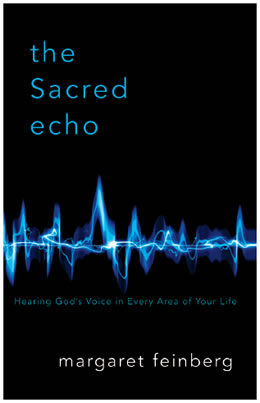 As I mentioned last week, I received an early copy of The Sacred Echo by Margaret Feinberg to review. I've been so immersed in reading a variety of books on the Apostle's Creed that I have just now found the time to sit down and read it, but it was worth the wait! The subtitle of the book is "Hearing God's Voice in Every Area of Your Life" and Ms. Feinberg explores the way God speaks to us again and again. Essentially, this is a book about a lifestyle of prayer--especially a lifestyle of listening for God's voice. She is very honest about the struggles involved in listening for God. She shares her own experiences of unanswered prayers and the frustration of calling out to God. But she also shares her experiences of hearing God's answer to her prayers--even when the answer was not what she expected and even those times when the answer while comforting was not what she wanted.
 The Sacred Echo is one of those books that is best savored. Read a chapter and reflect. In fact, she includes questions for reflection in the back. I plan to recommend this book to our Monday morning Women's Bible Study group because I think it would be an excellent resource for small groups. (I think they may in fact be going to release a DVD study based on the book.) However, this is not a "woman's" book but a book on spiritual development that is equally applicable to men's lives as to women's.
Each chapter of the book was based on some sacred echoes that she has heard from God. They were:
I love you
sing it again
how long?
read it again
you follow me
if you don't wear your crown
surrender
take care of my people
bring them to me
you are not alone
Then she invited others to share some sacred echoes they have heard in their own lives, so here are some I've heard through the years (not in any particular order):
What will you give in return for your life?
God chooses the foolish to confound the wise
There are giants in the land! But I will be with you!
Don't you trust me?
By my God I can leap over the wall
Guard what I has been entrusted to you
Is the Lord's power limited?
Feed my sheep
Woe to me if I do not proclaim the gospel
What are some things God has repeatedly whispered in your heart?
Thursday, October 23, 2008
Preparing for Sunday, Oct. 26th

We are quickly approaching the end of the series on the Apostle’s Creed. This week we will explore some of the many implications of believing in the resurrection of the body and life everlasting and then next week, we’ll pick up the line we skipped over—belief in the communion of saints. In order to explore the meaning of the resurrection of the body, we turn to the Apostle Paul, who had the most to say about the matter:
12Now if Christ is proclaimed as raised from the dead, how can some of you say there is no resurrection of the dead? 13If there is no resurrection of the dead, then Christ has not been raised; 14and if Christ has not been raised, then our proclamation has been in vain and your faith has been in vain. 15We are even found to be misrepresenting God, because we testified of God that he raised Christ—whom he did not raise if it is true that the dead are not raised. 16For if the dead are not raised, then Christ has not been raised. 17If Christ has not been raised, your faith is futile and you are still in your sins. 18Then those also who have died in Christ have perished. 19If for this life only we have hoped in Christ, we are of all people most to be pitied.Paul states that if we do not believe in the resurrection of the death then our faith is futile. How does the belief in the resurrection of the body and life everlasting influence your faith? What difference does it make in how you live your life daily?
20But in fact Christ has been raised from the dead, the first fruits of those who have died. 21For since death came through a human being, the resurrection of the dead has also come through a human being; 22for as all die in Adam, so all will be made alive in Christ. 23But each in his own order: Christ the first fruits, then at his coming those who belong to Christ. 24Then comes the end, when he hands over the kingdom to God the Father, after he has destroyed every ruler and every authority and power. 25For he must reign until he has put all his enemies under his feet. 26The last enemy to be destroyed is death. 27For “God has put all things in subjection under his feet.” But when it says, “All things are put in subjection,” it is plain that this does not include the one who put all things in subjection under him. 28When all things are subjected to him, then the Son himself will also be subjected to the one who put all things in subjection under him, so that God may be all in all. I Corinthians 15:12-28•
• This is just a short portion out of an entire chapter where Paul insists that it is vital that we not only believe that Christ was resurrected but that our bodies too will also be resurrected. This is clearly not a belief in just an immortal soul but of a resurrected (spiritual) body. Why do you think Paul insisted that we believe in the resurrection of the body? If our bodies are to be resurrected, what difference does that make in how we treat our bodies? What difference would it make in how we treat the bodies of others?
• Read through the entirety of 1 Corinthians 15. We most often hear these verses at funerals. 1 Corinthians 15:51-57 are the words that I recite at the beginning of a graveside committal service. What hope do we find there? What difference does that hope make in our daily lives?
• The creed ends with the words “Amen” which is Hebrew for “so be it.” What does it mean to end the creed as we end our prayers?
Just a few thoughts to ponder this week as we prepare for worship.
Wednesday, October 22, 2008
Sunday, October 19, 2008

Saturday, October 18, 2008

Friday, October 17, 2008
Weekly Review October 17

A few interesting reflections on the upcoming election:
McCain, Obama, Two American Exodus Stories
Decision '08 Is there a bigger decision than who we should vote for?
And on the current economic crisis:
Financial Crisis as time for reflection
Church Leaders Urge Stewardship
Our Worth Comes from God Not Money
Save All You Can Give All You Can
Wilderness Opportunities
What makes Judy Garland's "Over the Rainbow" so wonderful?
Porn and our kids
Perhaps my next sermon series should be on the Song of Solomon! (New Life folks: Don't worry I can't read it aloud without blushing!)
In honor of Joe The Plumber, 10 interesting facts about (licensed and unlicensed) plumbers!
Cleric Eric shares some interesting facts from his safari.
Anne Rice's Spiritual Confession
And now for a fun moment (Pastor's Warning: There is the use of one expletive (think of a donkey) in this video.)
Thursday, October 16, 2008
The Waiting Room
 I’m currently reading “The Sacred Echo” by Margaret Feinberg. She was one of the speakers at the National Pastor’s Convention last year and I mentioned her in old Trinity blog. As I result, I was offered a copy of her newest book and asked to read it and share my thoughts about it. I’m sure they have regretted giving me a copy! I’ve been so overwhelmed lately that I’ve taken my sweet time to read the book. The premise of the book is that when God wants to get our attention, God doesn’t just whisper once, but God’s voice will echo again and again in our daily lives.
 Some believe God repeats things because we often don’t hear God the first time. Others think God repeats because we are easily distracted. But Margaret Feinberg believes the reason for God’s echoes is that God so wants a relationship with us that God’s voice emanates out of God’s desire to connect with us. Personally, I wonder if God’s echo is the result of all three reasons. I do believe God is constantly at work trying to get our attention and trying to draw us into a close personal relationship. But I also know that I am so hard headed that I ignore some of God’s more subtle calls on my life. And still other times, I am so distracted that God finds it absolutely necessary to remind me again and again of what God has called me to do. Whatever the reason, God does whisper over and over to us in the midst of our daily routines. And when God really wants to get our attention those echoes seem to come fast and furious.
So yesterday, I was scanning the blogs I follow and found this article about transitional leadership. In this article, he refers to an article that discusses Saul’s son, Jonathon, and the difficulty he had as a leader with one foot in the old world of Saul and one foot in the new world being offered by David. The result, according to that author, was Jonathon’s death because of Jonathon’s inability to transition between one world and the next. But Len Hjalmarson pointed out that there was another model for transitional leadership. John the Baptist also lead during a time of transition. He too didn’t survive to see the new day but he knew that his ministry was one of preparing people to make the change from old to new and in so doing he honored both worlds.
Then a bit later yesterday morning, I was sitting in the waiting room at the Surgery Center and I opened up to the second chapter of “The Sacred Echo, “ entitled “how long?” In that chapter, she talks about the times that we pray to God and then we have to wait . . . and wait . . . and wait. Then she mentioned that when she thinks of waiting, she thinks of . . . John the Baptist, who found himself waiting in a prison cell. There the seemingly always confident John found himself questioning the very thing he had been called to proclaim. “Are You the Expected One, or shall we look for someone else?” Gone was the certainty of the day he baptized Jesus when he declared, “He must increase. I must decrease.” Then Jesus responds that they should report what they have seen and heard that “the blind receive sight and the lame walk, the lepers are cleansed and the death hear, and the dead are raised up, and the poor have the gospel preached to them.” Then she points out something very interesting—Jesus omits one particular sign of the kingdom “the prisoners will be set free.” So John waits and knows that he won’t see the dawning of the new day but that it is coming!
The times they are a’changin’! In a few weeks, we will elect a new President and, for good or ill, our government will change. In fact, both candidates are running on the claim that they will affect the most change. The current economic crisis is going to force us all to change how we buy, how we save, where we live, and how we look at money. Our conference is changing. We are looking at new ways of doing church, new ways of evaluating the effectiveness of pastors and churches, and new ways of reaching out to the next generation, which appears to be unimpressed with the way things have always been done. And my church is changing. The congregation is not as strong and as vibrant as they were a few years ago. They’ve accepted not only a new pastor but a woman pastor. Committees that haven’t met in years are now meeting again. We are about to approve a ministry budget—the first one in a couple of years. Change is all around us, but nothing seems to be getting any better yet. And those committed to the way things were are not happy. Those wanting things to be new—immediately—are not happy. And in the waiting room, comforting those who don’t want change and settling down those in a hurry to rush change at any cost stand John and Jonathon.
Sitting in the waiting room yesterday, I realize that God was trying to get my attention. For several years now I have felt betwixt and between. I’m a late boomer who thinks more like a post-modern. I’m a pastor over 35 but I’m new to the ministry. I value the wisdom of experienced pastors and I love the passion and energy of the younger pastors. I value the beauty of traditional worship but I see the need to adapt to reach a new generation. I hate meetings like a postmodern but I don’t know any other way to work as a team. I feel that I too have feet in the old world and the new.
But am I to be a Jonathon or a John the Baptist—die protecting the old or die proclaiming the new?
Or is there another model?
In Len Hjalmarson’s article, he maintained that he didn’t think of Joshua as a transitional leader because he completely left the old world to enter the new one. I’m not sure I agree. Even after he entered the Promised Land the first time and found himself wandering in the wilderness with a hardheaded group of folks who refused to enter the new and better world to stay, he didn’t grumble. He didn’t stomp his feet and complain about how they needed to change and do things his way. Instead, he waited. He waited actively—supporting Moses and working with the people—so that when the time came to enter the new world, the people were willing to be led by him. And even as they crossed into the new world, they built monuments honoring the old.
So today, I’ve decided to be a Joshua—honoring the old, awaiting the new, and ready and willing to lead God’s people into a new future.

Wednesday, October 15, 2008
Preparing for Sunday, October 19th

As we continue our reflection on the creed, we find ourselves at the line that declares that we believe in the communion of saints. However, I am postponing our discussion of the saints until Nov. 2nd when we will reflect on the saints in our lives and our congregation as part of our celebration of All Saints Sunday. So this week, we will focus on one of the key claims of the gospel: the forgiveness of sins. This truly is gospel—good news—for us because we are all in need of forgiveness!
8If we say that we have no sin, we deceive ourselves, and the truth is not in us. 9If we confess our sins, he who is faithful and just will forgive us our sins and cleanse us from all unrighteousness. 10If we say that we have not sinned, we make him a liar, and his word is not in us.
2My little children, I am writing these things to you so that you may not sin. But if anyone does sin, we have an advocate with the Father, Jesus Christ the righteous; 2and he is the atoning sacrifice for our sins, and not for ours only but also for the sins of the whole world. 1 John 1:8-2:2
1. Acknowledging our sinfulness, asking for forgiveness and repenting (turning) from our sins is a central part of our understanding of what it means to “be saved.” In many traditions, evangelism begins with informing people of their sinfulness and need for salvation. Yet, most of us (within and without the church) rationalize or ignore our sinfulness. How does the church live as a testimony to the truth of our sinfulness and the hope of our forgiveness?
2. But what does this passage say to those of us within the church—those who are, in Paul’s words, “being saved”?
3. When we pray the Lord’s Prayer together, we ask that God forgive our trespasses as we forgive
those who trespass against us. How is our forgiveness dependent on our ability to forgive?
4. Once again, we find beautiful words of faith directed toward a community that is fighting among itself! What difference should it make to us as a Christian community to say that we believe in the forgiveness of sins?
These are some of my thoughts this Wednesday. See you on Sunday!
Sunday, October 12, 2008
I Believe in the Holy Catholic Church

Since I was out of town last weekend, we observed World Communion Sunday a week late. But that did make it a great time to discuss what it means to believe in the holy catholic church.
Friday, October 10, 2008
Weekly Review October 10th

As someone frequently frustrated by the obsequious Left Behind books and their theology, I am ordering my copy of Left Behind or Left Befuddled soon!
Of course, I love you
Check out the 12 Tribes of Politics. Which tribe are you?
Looking for cool youthful clothes that make a difference in the world? Check out Jedidiah
Want to invest in something that really makes a difference? Check out Kiva and Opportunity International. (for my first day of the 10 Day Give, I've made a loan to Comfort Sam who sells rubber and plastic products in Ghana.
The SBC weighs in on whether a woman can preach or be vice-president.
Speaking of Sarah Palin, John Ortberg speaks out on churches and politics.
Thanks to the UM Worship Listserve Ruach, I discovered some new websites related to contemporary worship:
Spring Harvest
Worship Together
Praise Charts
Great Worship Songs
and the one I am most excited about:
Mustard Seeds
Image: Left Behind by Katrina Artists

Preparing for Sunday October 12th

This week’s focus is on what it means to believe in the holy catholic Church. Given much of what we see on a regular basis, this sometimes seems like the most ridiculous claim of the creed. How can we say the church is holy when it is made up of such ordinary and sometimes difficult individuals? How can we say the church is “catholic,” or “universal,” when we are divided into more denominations than we can count and we argue and fight even among them? How can we say it is catholic when Sunday morning is the most segregated time of the week? And why can’t we just give our lives to Christ, pray and study at home and just ignore this thing called Church?
I honestly doubt we’ll cover it all this week, but I look forward to reflecting on and celebrating this beautiful and frustrating gift of God called the Church!
Here is our scripture for this Sunday:
4I therefore, the prisoner in the Lord, beg you to lead a life worthy of the calling to which you have been called, 2with all humility and gentleness, with patience, bearing with one another in love, 3making every effort to maintain the unity of the Spirit in the bond of peace. 4There is one body and one Spirit, just as you were called to the one hope of your calling, 5one Lord, one faith, one baptism, 6one God and Father of all, who is above all and through all and in all. 7But each of us was given grace according to the measure of Christ’s gift. 8Therefore it is said, “When he ascended on high he made captivity itself a captive; he gave gifts to his people.” 9(When it says, “He ascended,” what does it mean but that he had also descended into the lower parts of the earth? 10He who descended is the same one who ascended far above all the heavens, so that he might fill all things.) 11The gifts he gave were that some would be apostles, some prophets, some evangelists, some pastors and teachers, 12to equip the saints for the work of ministry, for building up the body of Christ, 13until all of us come to the unity of the faith and of the knowledge of the Son of God, to maturity, to the measure of the full stature of Christ. 14We must no longer be children, tossed to and fro and blown about by every wind of doctrine, by people’s trickery, by their craftiness in deceitful scheming. 15But speaking the truth in love, we must grow up in every way into him who is the head, into Christ, 16from whom the whole body, joined and knit together by every ligament with which it is equipped, as each part is working properly, promotes the body’s growth in building itself up in love. EPHESIANS 4:1-16
1. What does it mean to say we believe in “one body and one Spirit . . . one hope of your calling, one Lord, one faith, one baptism”? What does that say about denominational differences? What does it mean to believe in “one faith”? What makes the “one baptism” effective?
2. What does the image of the church as the body of Christ tell us about the nature of the church and the nature of the unity it exhibits?
3. What is the role of the Holy Spirit in all of this?
4. If we believe in the one body of Christ, what does it say about our strong reactions for and against certain denominations within that body?
5. Paul begs us to lead a life worthy of our calling. The Greek word for church is Ekklesia – or “to call out.” What would you need to change in your life if you were to live a life worthy of being a part of those who are “called out,” that is The Church?
See you on Sunday!
Thursday, October 9, 2008
Join Me in the 10 Day Give
Perhaps the greatest problem with stressful times like ours is that our focus moves from God and others to our safety and security. So as we listen to the stock market do its thing and wonder if the situation in Iraq will ever be resolved, and worry over who will be our next president and what will it mean, perhaps this is the best time to stop for a moment each day to focus on someone else. So I'm inviting you to join me in the 10 Day Give!
Friday, October 3, 2008
Weekly Review October 3rd

Quite honestly, this is more of a monthly review! Sorry I've been so behind but I've been busy with church and conference responsibilities and now I'm preparing for a trip to West Virginia for my grandparent's 70th anniversary! But here is a sampling of articles that have caught my attention lately!
I'm sure all of you have wondered how the candidates shape up against the teachings of the United Methodist Church! If so, check out this guide.
Are we born liberal or conservative?
I'm working on it, but are you comfortable being uncomfortable? To what extent are you willing to change for the sake of a new generation?
Sarah Palin has brought Pentecostalism to the attention of the media, but it is also one of the fastest growing parts of Christianity in the world. Sarah Palin and Women Preachers!
Is there a relationship between sobriety and stewardship?
More on the Gospel Today Controversy.
What questions should pastors ask themselves as they leave church each Sunday?
Want to increase church attendance? How about advertising the fact that statistics show that teens who attend church regularly have higher GPAs?!
The Truth about Teen Girls
Jail and Jesus
What stock would Jesus buy?
3 Signs of a Miserable Job
I'll miss Paul Newman! I have a soft spot for good looking actors who know how to make a marriage work!
What to do when your teen complains about church? Make him or her go!
College students are rebelling! Forget that contemporary stuff, give them liturgy!
See you when I get back from Terra Alta!
Image: Steven and I at Grandpa and Grandpa's 50th Anniversary Celebration!
Sarah Palin and Gospel Today

Two unrelated news items of the past few weeks have me reflecting on the role of women today: Sarah Palin and the Gospel Today controversy. I suspect no one reading this blog is unaware that Sarah Palin is the Republican nominee for vice-president of the United States. She is the darling of conservative Christian Republicans which is strange since many of them hold to a strict interpretation of scripture which would never allow Sarah Palin to preach in their churches! (I’ll share a few reflections on this dichotomy in my weekly review). However, some of you may be unaware of the controversy over this month’s Gospel Today magazine which features women senior pastors on the cover. Lifeway has placed the magazine behind the counter at their stores. You can buy it, but you must ask for it. Essentially treating the idea of women in ministry as we treat pornography!
As a young child, I remember the old Virginia Slims ads: “We’ve come a long way, baby!” And we have—in less than a hundred years we have been granted the right to vote; we’ve taken our place in the workplace; and we’ve had two women as vice-presidential candidates and nearly had a woman as a presidential candidate. No one blinks anymore if you meet a woman lawyer or doctor or mayor or governor. Yet, within the church, women have not come quit as far! The Methodist Church has been ordaining women for over fifty years; yet within my conference less than 15% of pastors are women. Despite the fact that I live in one of most highly educated areas of the country, I am often the first woman pastor anyone has met or heard preach. And since moving to New Life, I have been even more aware of my gender and the “problem” that my gender creates in my ability to do ministry.
The past 100 years has brought unprecedented change in all areas of our lives. We’ve gone from horse and buggy to the space shuttle; from telegraph to internet; from the front porch to chat rooms. Within our faith, we have gone from one primary English translation (KJV) to a myriad of possibilities, a handful of denomination to a myriad of worship possibilities; from people with ethnic identifications to an increasing multi-racial population. So much change! And I wonder if our attitudes toward women’s roles have not taken on some of the weight of the stress of all this change.
What does it say about our culture (if anything) that we can consider a woman as president and vice-president but not as our pastor? What does it say that some will vote for or not vote for a woman based solely on her gender? What does it say that some of us (me included) couldn’t bring themselves to vote for either major woman candidate because of the feeling that they are too masculine in their leadership styles?
I remember soon after I was appointed to Trinity, I received an e-mail from some man in Athens (Alabama) asking how I justified being in ministry and my response was simply that God called me and the only way I could be faithful to God was to respond to that call. And that on judgment day, I was the one who would stand before God and make an accounting and I didn’t want to be found unfaithful. I still don’t think of myself as a feminist. But I find myself confused to be in a place where I am judged heretical to follow God’s calling on my life by people who will vote for a woman to be a heartbeat away from the presidency of the United States.
I don’t have any answers to these questions. They’ve simply been rolling around in my head this week.
Subscribe to:
Posts (Atom)